Last Updated on November 1, 2026 by Daniel Osakwe
We’re going to take a closer look at the Palo Alto PA-200 Firewall, a $1,500 entry-level firewall that aims to keep you safe online. Read on for our full review.
Table of Contents
Introduction
There’s no shortage of firewall products on the market, and most of them are pretty good. But many of these products are aimed at the enterprise market, where prices can easily reach into the thousands of dollars.
The Palo Alto PA-200 Firewall is different: it’s aimed at the consumer market, and it costs a lot less. At $1,500, it’s not cheap, but it’s also not a prohibitively expensive purchase, and it’s still a lot cheaper than buying a whole PC to run a firewall.
What are the benefits of the Palo Alto Firewall PA-200?
PA-200 offers you the same PAN-OS features that protect your data centers. You can use it either in active-active or passive-active modes for high availability. At high throughput speeds, the PA-200 provides you with interactive visibility and control of applications, users, and content.
Additionally, you’ll enjoy consistent power input for increased reliability, a fanless design for quiet operation, and compact state disks to eliminate any moving parts. Through the USB port, the PA-200 can also be used to distribute large numbers of firewalls.
Using a Palo Alto PA Series firewall as your main firewall, NAT or VPN gateway or content filtering gateway is a smart choice. By integrating all of these features into one device, it simplifies management and design. Additionally, it handles AD and terminal server user identification requirements well, which is something that many other products fail to do. You can manage all of your Palo Alto firewalls from a single Panorama server, so it scales well.
Cloud apps are being deployed more frequently, more devices are being brought into branch offices, and bandwidth usage is on the rise. MPLS, for example, is expensive to deploy, slow to provision, and offers limited bandwidth in many locations.
Many businesses are interested in software-defined wide-area networking, or SD-WAN. When organizations switch from MPLS to SD-WAN, they end up compromising on security, end-to-end performance, and simplicity of operation. Using Palo Alto Networks, you are assured of world-class security, a high-performance backbone via Prisma Access, and the ease with which you can consume secure connectivity.
Pros and Cons
| Pros | Cons |
| Wildfire Feature Provides Up-To-Date Info On Global Attack Mitigations And Stopping techniques | Nested Security Rules Would Be Helpful As Opposed To A Linear approach |
| Centralized Management | Booting Issue |
| Private Network | No Moving Parts |
| High Availability | Blocking the VPN traffic from a DMVPN router |
| Tighter Security Policies | |
| GlobalProtect VPN Connection To Help Employees Connect From Home Remotely |


Palo Alto PA-200 Firewall: Key Features
Consistent Architecture and Compact Implementation
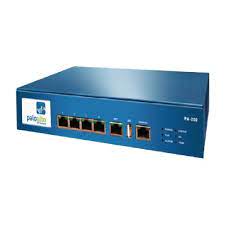
With the PA-200 desktop form factor, you can use the same PAN-OS features that protect your largest data centers, including high availability with active/active and active/passive modes for small organizations or branch offices. With throughput speeds of up to 100 Mbps, it offers interactive visibility and granular control of applications, users, and content.
Application Classification
Using your safe enablement policy, the PA-200 identifies any application, regardless of port, encryption (SSL or SSH), or evasive techniques used, and uses the application, not the port, for all decision-making: allow, deny, schedule, inspect and apply traffic-shaping. In addition, it categorizes unidentified applications for policy control, threat forensics, and custom App-ID development.
Security Policy Reinforcement
Users can deploy consistent policies to local and remote users on Windows, macOS, Linux, Android, and Apple iOS platforms using the PA-200. You can easily integrate your firewall policies with 802.1X wireless, proxies, network access control, and other sources of user identity using agentless integration with Microsoft® Active Directory and Terminal Services, LDAP, and Novell eDirectoryTM, as well as with LDAP and LDAP, Novell eDirectoryTM, and Citrix.
Prevents Known And Unknown Threats
In spite of common threat-evasion tactics, the PA-200 blocks a range of threats, including exploits, malware, and spyware. The program prevents the unauthorized transfer of sensitive data and files in order to allow non-work-related web browsing. The software also detects unknown malware, analyzes it using hundreds of malicious behaviors, and then automatically creates and delivers protection.
Cloud-Delivered SD-WAN
With this product, Prisma Access, and CloudGenix’s SD-WAN converge to provide a seamless end-to-end solution to our customers, allowing them to seamlessly onboard remote branches and retail stores. In this joint solution, network and security transformation requirements are addressed, accelerating the transition to SASE, Secure Access Service Edge.
Why is SASE so important and how will it benefit your business? By combining cloud-based firewalls (FWaaS), cloud access service brokers (CASB), and software-defined networks (SD-WAN), SASE creates a Zero-Trust model. It is a security model that does not automatically trust anything within or outside the perimeter of its network. It requires layers of authentication or verification before accessing sensitive or protected information.
LDAP Support
Lightweight Directory Access Protocol (LDAP) specifications are published as Request for Comments (RFCs) by the Internet Engineering Task Force (IETF) using the ASN.1 description language. The latest specification is Version 3, published as RFC 4511, (a road map is provided by RFC4510).).
Simply put, LDAP is a standard protocol for accessing information directories. LDAP is commonly used to store usernames and passwords in a central location. This allows many different applications and services to connect to the LDAP server to validate users. So how does this affect users? You can define policy rules based on users and users groups instead of IP addresses when configuring the PA-200 to an LDAP server.
VLAN Support
With virtual LANs (VLANs), network administrators can divide a physical network into logical broadcast domains. The broadcast domain on a Layer 2 network is a collection of all hosts connected to a switch, and broadcast domains are only physically separated by routers. In order to segment traffic for performance, security, or logistics reasons, networks must introduce multiple broadcast domains as they scale. In the absence of VLANs, this would require each network segment to have its own separate switch infrastructure, with one or more routers managing communication between each switched segment.
Traffic Classification
PA-200 can classify traffic and unidentified applications regardless of port, encryption (SSL or SSH), or evasive techniques used. In order to determine which applications traverse your network, multiple classification mechanisms are applied to the traffic stream. They detect threats or malware as well.
Cyber Attack Prevention
When traffic is properly classified, you can reduce the network threat footprint by allowing specific applications and blocking others to protect your network from various cyberattacks. In this way, coordinated cyber-attack protection can be applied to the allowed traffic, blocking known malware sites, preventing vulnerabilities, viruses, spyware, and malicious DNS queries.
The malicious code found in the applications on your network is analyzed by directly observing its malicious behavior in a virtual sandbox environment while the files are executed. Whenever new malware is discovered, a signature is automatically generated for the infected file and related malware traffic.
IPv6 Support
In its simplest form, IPv6 identifies devices across the Internet so that they can be located. IPv6 uses end-to-end datagrams to transmit identification information across multiple IP networks, a process closely analogous to IPv4’s design principles. In contrast to IPv4, IPv6 offers more addresses and simplifies packet processing in routers since it places the responsibility for packet fragmentation on the endpoints.
IPSec Virtual
Virtual Tunnel interfaces support IP security (IPsec) tunnel termination and provide an easy way to form an overlay network by defining protection between locations. Multicast support, simplified network management, and simplified load balancing are all features of IPsec VTIs that simplify the configuration of IPsec for remote links.
IPv4 Support
In addition to version 4 (IPv4) of Internet Protocol (IP), Palo Alto PA-200 supports IP version 3. In the Internet and other packet-switched networks, it is one of the core protocols of standards-based Internet working methods.
cCSAus, CB Safety
The IECEE CB Scheme, operated by the IEC System of Conformity Assessment Schemes for Electrotechnical Equipment and Components (IECEE), is an international system for mutual acceptance of test reports and certificates that deal with the safety of electrical and electronic components, equipment, and products.
Palo Alto PA-200 Firewall: Other Features
- 100 Mbps firewall throughput
- 50 Mbps Threat Prevention throughput
- 50 Mbps IPsec VPN throughput
- 64,000 max sessions
- 1,000 new sessions per second
- 25 IPsec VPN tunnels/tunnel interfaces
- 25 SSL VPN users
- 10 security zones
- 250 max number of policies
Palo Alto PA-200 Firewall: Specifications
| Firewall Throughput: | 100Mbps |
| Maximum New Sessions Per Second: | 1000 |
| Maximum Concurrent Sessions: | 64000 |
| Integrated I/O: | 4x Gigabit Ethernet |
| Storage Capacity: | 16GB SSD |
| Serial Ports: | LAN and USB |
| Form Factor: | Desktop |
| Power Supply: | 40W |
| Dimensions: | 234.95 x 177.8 x 44.45mm |
| Weight: | 1.27kg
|
Observations
It is easy to configure the PA-200, so easy that a highly qualified security engineer is not necessary to manage it. From a small business office with the PA-200 to a large business office with the PA-5x series, management is very similar. Building blocks such as security rules, objects, and schedules are very easy to find. Users can easily navigate through the interface.
In terms of the interface, there are a few quirks, but nothing too bad, especially since the v7 update. UserID can be beneficial in a corporate environment that utilizes LDAP/Active Directory in order to create policies according to users or groups of users. Moreover, AppID reduces attack surfaces, and Wildfire and other antivirus/malware features are automatically updated to provide an extremely up-to-date package of protection.
Palo Alto’s PA-200 is one of the best network firewalls on the market, but it is best suited for small organizations, branch offices, and retail locations. The PA-200 has a strong traffic classification feature. Despite its lack of moving parts, the Palo Alto PA-200 is an excellent network firewall for small networks.