
Last Updated on November 1, 2026 by Daniel Osakwe
List of the Best Smart Thermostats
| Products | Features | Where to Start |
| Ecobee smart thermostat
|
|
Get it on Amazon |
| Nest Learning Thermostat v.3
|
|
Get it on Amazon |
| Honeywell RTH8580WF Wi-Fi Thermostat
|
|
Get it on Amazon |
| Ecobee3 Lite
|
|
Get it on Amazon |
| Sensibo Sky
|
|
Get it on Amazon |
| Nest Thermostat E
|
|
Get it on Amazon |
| Honeywell Home T9 Smart Thermostat
|
|
Get it on Amazon |
| Netatmo smart thermostat
|
|
Get it on Amazon |
| Drayton wiser thermostat
|
|
Get it on Amazon |
| Tado smart thermostat
|
|
Get it on Amazon |
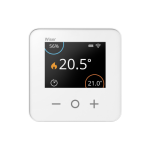
Welcome to our best smart thermostats review. Below, we’ve highlighted the best smart thermostats in the market. So, getting the best to buy wouldn’t be an issue anymore.
However, before proceeding, we’ll like you to take a look at the buyer’s guide section below for more info on how to select the right smart indoor thermostats.
Table of Contents
Buyers Guide: What to Look for in a Smart Thermostats Before Buying
High-voltage heater support: Most smart indoor thermostats are intended to work with focal HVAC systems. In the event that your house is warmed by high-voltage thermostats (baseboard, brilliant, and fan-constrained convector, for instance), you’ll need indoor thermostats that are explicitly intended to work with that kind of heater.
Remote Access: Remote access empowers you to control your indoor thermostats from a remote place, with the goal that you can check in and change the temperature from any place you have an association with the web.
Sensors: Geofencing is incredible—given every individual who lives in the home has a cell phone. Movement and closeness sensors offer elective methods for deciding whether your house is involved and therefore needs atmosphere control. The first Nest indoor smart thermostats were frequently condemned for depending a lot on its movement sensor. On the off chance that nobody strolled past it frequently enough, it would conclude that the house was vacant and it would quit warming or cooling.
Some smart indoor thermostats can likewise take advantage of door and window sensors just as the motion sensors for your home security framework. Also, closeness sensors on the indoor thermostats themselves can trigger an indoor thermostat presentation to turn on when you stroll past it, making the screens a helpful element in their own right, regardless of whether for no other explanation than giving an evening time pathway light.
Best Smart Thermostats in Compactibility
Ecobee smart thermostat
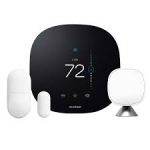
Works With: Amazon Alexa, Apple HomeKit, Google Assistant, Samsung SmartThings, Logitech, Wink, IFTTT | Remote Sensors: Yes | Self-Installation: Yes | Motion Activation: Yes | Works Offline: Yes
Every smart indoor thermostat accompanies an application so you can control it with your cell phone or tablet, yet as well as can be expected additionally be incorporated with other smart home gadgets and more extensive smart home frameworks.
This can go from having the option to change the temperature with a voice order by means of an Amazon Echo or Google Home advanced collaborator, to connecting to your smoke alarm so your fan consequently kills when a fire is identified, keeping smoke from being circled all through your home.
Different alternatives to consider incorporate IFTTT and Stringify uphold, Apple HomeKit similarity, smart vent network, and connections with home security frameworks.
| Pros | Cons |
| Full Alexa support | Large |
| Works with Spotify |

Nest Learning Thermostat v.3
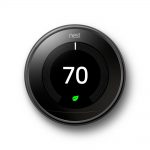
Works With: Amazon Alexa, Google Home, Logitech, IFTTT, Samsung SmartThings, WeMo, Wink, Xfinity | Remote Sensors: No | Self-Installation: Yes | Motion Activation: Yes | Works Offline: Yes
The Nest Learning Thermostat was the first smart indoor thermostat, and its exemplary plan actually stands apart among the opposition. The third form of this Google-claimed indoor thermostat has a bigger and more honed show than its archetype. Like previously, the Nest Learning Thermostat learns your conduct after some time, so it can consequently change the temperature when somebody gets back home.
While the Nest indoor thermostat has a retro-style roundabout plan, its brushed stainless steel finish and turning system all vibe premium. Besides, it arrives in an assortment of completes the process, including Brass, Polished Steel, Copper, and White, so it can all the more effectively fit in with your home stylistic theme. This indoor regulator joins the best of the past with the future and is extraordinary compared to other smart indoor thermostats that are Google Home viable.
| Pros | Cons |
| Large display | Doesn’t work with Apple HomeKit |
| Easy to install | Can’t monitor temperature in multiple rooms |
Tado smart thermostat

The Tado Smart Thermostat associated with a more extensive scope of a heating systems than generally, working with 95% of the frameworks out there, evidently — it underpins combi and customary ovens, electric under-floor arrangements, and high temp water frameworks. Similarly, as with the majority of our best smart indoor thermostats, the establishment is best done by a certified specialist. The Tado smart indoor thermostat is sufficiently smart to become familiar with the design of your home and the heat capacity of your home, so on the off chance that you need it to be 18 degrees at 7 am, it’ll fire up ahead of time if necessary to hit the objective.
Ostensibly the genuine executioner highlight is Tado’s utilization of geofencing, however: by following the vicinity of your portable, when it distinguishes you’re in transit home, it can turn up the heat so it’s hot on your return. The application is programmable, similar to a typical indoor thermostat, and can be physically abrogated when required. It additionally shows a wide range of data about your energy use, in spite of the fact that the key cash sparing details are subject to your info.
Tado likewise works with Alexa, Google Assistant, and Siri, which adds to its accreditations as outstanding amongst other smart indoor thermostats of 2021. Just as the £199 unit value, there are different additional items to consider (counting an Extension Kit if your present framework has no wired room indoor thermostat). Tado presently does a scope of smart radiator valves as well, that can be utilized with or without the indoor thermostats, adding to its case to be the best smart indoor thermostat out there. These are desirable over adversaries from Eve and Wiser (they’re more conservative, with a little screen to show the current temperature).
| Pros | Cons |
| Easy to use thermostat and app | Expensive |
| Valves have a display too |
Ecobee3 Lite
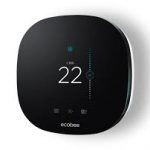
Works With: Alexa, Google Assistant, Apple HomeKit, Samsung SmartThings, Logitech, Wink, IFTTT | Remote Sensors: Yes | Self-Installation: Yes | Motion Activation: Yes | Works Offline: Yes
Like the fifth-generation Ecobee indoor thermostat, yet couldn’t care less for Alexa, and are searching for something more affordable? The Ecobee 3 Lite has a large number of similar highlights as Ecobee’s top-end model yet costs $80 less. The Ecobee 3 Lite has a shading touchscreen, instinctive interface, and profound smart home coordination.
Furthermore, Ecobee additionally refreshed the Lite model to work with far-off sensors so you can set it to keep the heat on until a room in the furthest corner of your home arrives at a specific temperature. Notwithstanding, you need to buy those sensors independently. The Ecobee 3 Lite works with Apple HomeKit, Google Assistant, and Alexa, however, not at all like the Ecobee fifth-gen, Amazon’s voice aide isn’t incorporated with the indoor regulator.
It likewise doesn’t support HVAC extras, so you can’t utilize it if, state, you have two-stage warming and cooling. It additionally needs eco+, which learns your timetable and prescribes changes to help set aside your cash.
| Pros | Cons |
| works with remote sensors | Lacks geofencing |
| Easy installation |
Best Indoor Smart Thermostats in Affordability
Honeywell RTH8580WF

Works With: Amazon Alexa, Google Home, IFTTT, Samsung SmartThings, Wink, | Remote Sensors: No | Self-Installation: Yes | Motion Activation: No | Works Offline: Yes
The Honeywell RTH6580WF Wi-Fi Thermostat is the best smart indoor thermostat for those on a careful spending plan since offers a significant part of similar usefulness as better quality models, yet costs under $100. Like the Nest and Ecobee smart indoor thermostats, you can control the Honeywell RTH6580WF from your cell phone, and interface it to Alexa and Google Assistant, which not just lets you change the temperature with your voice yet connect it with other smart home items.
Also, the Honeywell Home environment incorporates a wide scope of accomplices, including Arlo, Apple HomeKit, SmartThings, Lutron, Kwikset Kevo, and then some. What you don’t get with the Honeywell RTH6580WF are the smart looks of the Nest, nor the far-off sensor abilities found with the Ecobee. However, in the event that all you’re searching for is a smart indoor thermostat that conveys on the rudiments, this is an incredible model to consider.
| Pros | Cons |
| Works with a lot of smart home equipment | Simple design |
| Affordable |
Sensibo Sky

Works With: Alexa, Google Home, IFTTT | Remote Sensors: No | Self-Installation: Yes | Motion Activation: No | Works Offline: No
Most smart indoor thermostats are intended for homes that have central heating and cooling frameworks, however, imagine a scenario in which you live in a more seasoned house or condo, and depend on window climate control systems to keep things cool. There are a couple of organizations that make smart indoor thermostats for this reason, and of them, we think the Sensibo Sky is the best smart indoor thermostats for those with in-divider or window climate control systems that have IR controllers.
The Sensibo Sky is reasonable, costing around $100, and was anything but difficult to set up, matching with our window A/C unit instantly. While the Sensibo Sky doesn’t have any showcase to display the temperature, we preferred its little, unnoticeable plan. We likewise loved that it tends to be controlled distantly, and lets you make plans for when they should turn on and off. It even has geofencing, so it can turn your AC on as you return home. Well, that is cool.
Sensibo has a more current form, the Sensibo Air ($179), which additionally incorporates a movement sensor; this can be designed with the goal that the Sensibo Air will kill your forced air system when nobody is, at this point present, and walk out on when somebody goes into the room.
| Pros | Cons |
| Easy to set up | No controls or display on device |
| Works with Alexa, Google Assistant and IFTTT |
Best Indoor Smart Thermostats in Efficiency
Nest Thermostat E
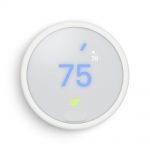
The Nest Thermostat E is another great smart indoor thermostat for under $200. It’s simpler to set up than the pricier Nest Learning Thermostat, yet has huge numbers of similar highlights. In any case, the Nest Thermostat E doesn’t uphold the same number of HVAC frameworks, nor does it back such highlights as two-stage heating and cooling. For most property holders, this shouldn’t be an issue.
The Nest Thermostat E has a similar shape as the Nest Learning Thermostat, yet rather than metal, it’s produced using plastic. Also, the Nest Thermostat E just comes in white, as opposed to the huge number of completions for the pricier Nest Learning Thermostat. Ultimately, the Nest Thermostat E’s all-white display can be difficult to read from far. Yet, in case you’re searching for something somewhat more affordable than Nest’s exceptional indoor thermostat, the Nest E is one to consider.
| Pros | Cons |
| Cheaper than original Nest | White display can be hard to read |
| Works with Alexa and Google Assistant | Does not support two-stage heating/cooling |
Honeywell Home T9 Smart Thermostat
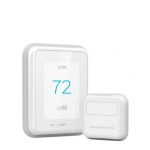
Works With: Alexa, Google Home, IFTTT | Remote Sensors: Optional | Self-Installation: Yes | Motion Activation: No | Works Offline: Yes
The Honeywell T9 fuses what we believe is perhaps the best element for a smart indoor thermostat: wireless sensors that can quantify the temperature and check whether there’s an individual present so the indoor thermostat can all the more likely change your HVAC framework to ensure all rooms are comfortable. You can buy it with a far-off sensor for around $199, or without a sensor for around $169. Honeywell’s T9 smart indoor thermostat has a rectangular shape, which gives it a more present-day appearance than, state the Nest.
We likewise like its enormous, splendid presentation that strongly shows the current temperature. The Honeywell T9 works with both Alexa and Google Assistant, and it has a geofencing highlight, so the indoor thermostat realizes when you’re approaching home and will change the temperature as needs be. Nonetheless, the Honeywell application could be simpler to utilize, and this smart indoor thermostat doesn’t support Apple HomeKit.
| Pros | Cons |
| Responsive sensors | No Apple HomeKit integration at launch |
| Easy to set up |
Netatmo smart thermostat

Netatmo, the French organization that altered the home climate station, has utilized the administrations of item originator and Frenchman Philippe Starck to make its interpretation of the modest indoor regulator. Furthermore, here it is, a clear plexiglass 3D shape with a basic display. Given that it’s planned by one of Europe’s principal creatives, the good old dark e-Ink screen and white packaging feel somewhat common, particularly close to something like the Nest. In any case, looks aren’t all that matters — Netatmo predicts its indoor smart thermostat will spare the normal client about 37% in energy costs, so’s a clear reward.
Once more, everything here is controlled through the free Android and iOS applications and arrangement is a doddle. At the beginning establishment, it’ll pose you five straightforward inquiries and afterward make a timetable dependent on your way of life. Another cool element is that the indoor thermostat itself can be introduced in two different ways: as a wired swap for your present unit or remotely, utilizing three AAA batteries. The wireless alternative permits you to put the indoor regulator in any room which is convenient on the off chance that you utilize one room more than the other.
In the event that you actually need persuading that this is extraordinary compared to other smart indoor thermostats out there, the Netatmo is likewise one of the less expensive alternatives you can get (however it’s not too prepared as a portion of its opponents), and it works with EDF Energy’s HeatSmart.
| Pros | Cons |
| Easy to use | Old-fashioned E-Ink display– |
| Energy saving |
Without pressing in an excessive number of additional fancy odds and ends, the Drayton Wiser Thermostat system offers outstanding among other smart indoor thermostat alternatives in 2020: smart control of temperatures from your telephone, and separate radiator valves. That implies you can redo the warming in each room in the event that you have to, and the application gives you a decision of preset modes to pick from on the off chance that you would prefer not to spend an excessively long time designing everything.
Amazon Alexa and Google Assistant help is incorporated here too. While it doesn’t have a similar sort of brand acknowledgment as something like a Nest or a Tado, the Wiser system does a ton of similar positions at an extremely engaging cost and is certainly worth considering. We particularly like the manner in which you can begin little with a radiator indoor thermostat, and afterward include more varying: you get a degree of control and calibrating that not all the gadgets on this rundown can coordinate.
There are little things that allude to where the experience isn’t exactly as smooth as any semblance of Nest of Tado – for instance, geofencing is done through IFTTT, as opposed to legitimately, making it more convoluted to set up – yet for the individuals who need the both smart highlights and multi-zonal control at a lower cost, it’s a truly solid choice.
| Pros | Cons |
| Choice of packages | None found |
| Affordable |
Test Process
During our testing, we relied on the opinion of experts and feedback of clients based on these major factors: Compactibility, Affordability, and, Efficiency.
More analysis of these smart thermostats were uncovered from further research and online reviews. From the result and feedbacks (both positive and negative), we were able to categories each product according to our standard.
If you take a critical look at our review, you’ll discover the manner in which each thermostat has been categorized. Also, take note that after our testing, the smart thermostats that weren’t up to standard were excluded from our list.
Frequently Asked Questions
Conclusion
Picking the best smart thermostats is something that ought to be considered important and without missing words, we believe that this review must have helped you in finding the right type of thermostats you need. Be that as it may, ensure you check all the necessary details of your preferred choice before purchasing.


