Last Updated on November 1, 2026 by Daniel Osakwe
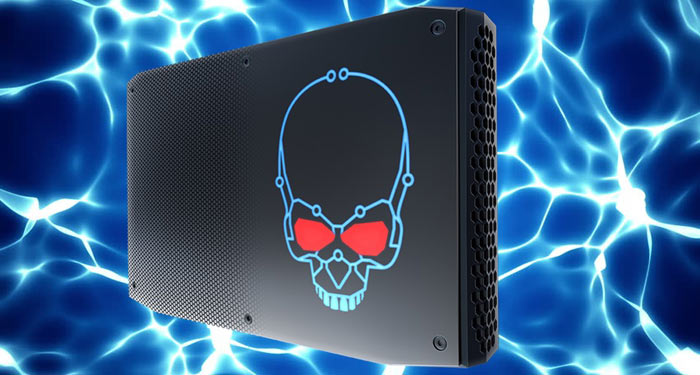
A review of the Intel Hades Canyon NUC mini PC.
I’ve been thinking about doing a review of the Intel Hades Canyon NUC mini PC for quite some time now, but I kept putting it off because I couldn’t make up my mind. So when I was given a couple of these bad boys by Intel, I jumped at the chance to try them out.
The Intel Hades Canyon NUC mini PC is a small form factor PC, which means that it has a lot of similarities with the Raspberry Pi Zero W. But as I said, there are some key differences, such as the fact that the Intel Hades Canyon NUC mini PC has an Intel Core i7 CPU and a GeForce GTX 1060 GPU. It also has USB 3.0, HDMI 2.0, an SD card reader, and it’s also a customizable PC.
Having said that, let’s find out more about this PC and why you should go for it.
Table of Contents
Design of the Intel Hades Canyon NUC
- Compact size
- Customizable
- Lightweight
Hades Canyon is a small, black brick that you can easily slip into your bag or slide into your entertainment center, just like Intel’s previous gaming-oriented NUCs.
Compared to the Kangaroo Plus Mobile Desktop (4.9 x 3.2 x 0.5 inches), it’s larger but much thinner and smaller than the Alienware Alpha (7.9 x 7.9 x 2.2 inches). The size of this device is barely larger than a video game console.
At first glance, Hades Canyon doesn’t look impressive. When the NUC is powered on, its top panel emits a skull-shaped glow. The LED Manager app allows you to change the skull and eyes’ colors, along with setting them to pulse rapidly or inhale and exhale.
Additionally, you can customize the colors of the front-facing lights to correspond to specific things, such as whether your power plug or Ethernet cord is plugged in. Do you want to completely disable the LEDs? That is also possible. For a PC of this size, the NUC’s RGB options are very robust, and I appreciate that the skull is LED-based rather than etched into the design like the previous model, Skull Canyon.
Intel Hades Canyon NUC: ports
- SD Card slot.
- Two USB 3.0 ports.
- audio jack
- HDMI Port
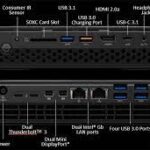
The Hades Canyon NUC is absolutely packed with ports, despite its small size. The mini PC comes with two USB 3.0 ports, a USB-C port, an SD card slot, a 3.5mm headphone jack, and a dedicated HDMI port for easy VR connectivity.
On the back, there are four USB 3.0 ports, two Thunderbolt 3 ports, two Ethernet ports, and an optical audio jack. A mini DisplayPort 1.2 port and an HDMI port also make it possible to connect to your monitors.
Intel Hades Canyon NUC: What’s in the Box
The Intel Hades Canyon NUC is a bare-bones system, so all you get out of the box is the PC’s Intel Core i7-8009G/AMD Radeon RX Vega M GH hybrid processor. You will be responsible for providing your own memory, storage, and operating system.
For this review, Intel provided us with a 512GB Intel 545s series SSD ($139), an Intel Optane SSD 800P ($115), two units of HyperX 8GB DDR4-3200 RAM ($94 each), and a copy of Windows 10 ($119). The price of a fully configured NUC will depend on what items you decide to put in it, but these components, combined with our $999 review unit, come to about $1,400.
Gaming performance on the Intel Hades Canyon NUC:

The NUC’s main selling point is its 8th-Gen Intel Core i7 with Radeon RX Vega M processor (also known as Kaby Lake G), which combines a traditional Intel CPU with discrete AMD graphics in one chip.
Based on our testing, the NUC delivered comparable performance to an entry-level GTX 1050 Ti gaming tower, and it even handled virtual reality.
It also beat Lenovo’s compact Legion Y720 Cube desktop (52, GeForce GTX 1050 Ti) but fell short of our gaming desktop average of 87 frames per second.
With both machines delivering a highly playable 33 fps while trailing our 82-fps average on Grand Theft Auto V (1080p, max settings), the NUC tied the Legion.
Although Intel’s tiny desktop computer can handle virtual reality, do not expect optimal performance. On the SteamVR Performance Test, the NUC scored 4.6 points out of 11, earning it a “medium” grade. Thus, it is capable of producing virtual reality, but it is not recommended for the highest level of fidelity.
On the synthetic test of 3DMark Fire Strike, the NUC scored 8,451. Unlike the Legion (6,166), the NUC’s average is much lower at 14,070.
Performance of the Intel Hades Canyon NUC
It proved to be just as capable of everyday multitasking as it was for gaming.
During our Geekbench 4.1 overall performance test, the NUC scored 17,683, topping the Legion Y720 (8,110; Intel Core i3-7100U), but falling far short of our 18,238 category average.
The 512GB Intel 545s series SSD in our unit copied roughly 5GB of files in 16 seconds, putting it at 310 MB per second. It beats the score for the 1TB hard drive on the Legion (69 MBps), but just misses our average gaming performance of 343 MBps.
Configurations of the Intel Hades Canyon NUC
Hades Canyon’s NUC is available in two configurations: a configuration meant for content creators for $799 and an overclocked, VR-ready option for $999. It features a Core i7 Kaby Lake G CPU, but the former has Radeon RX Vega M GL graphics (comparable to an Nvidia GTX 1050), whereas the latter has Radeon RX Vega M GH graphics (comparable to an Nvidia GTX 1060 Max Q).
Advantages and Disadvantages
| Pros | Cons |
| Programmable RGB lighting | Expensive |
| There are tons of ports. | |
| An attractive, compact design. | |
| Graphics performance is impressive. |


Our Verdict
With its mid-range gaming performance and respectable VR capabilities in an incredibly small chassis, Kaby Lake-G’s Hades Canyon NUC is an excellent example of Kaby Lake-G’s potential. The RGB lighting is a nice touch, and the system’s numerous ports make it ideal for living rooms and command centers alike.
In exchange for its superior performance, the NUC costs quite a bit. If you add your own memory, storage, and operating system to the highest-end, VR-ready nook, then you’re looking at up to $1,400 in total. In fact, you can get a comparably powerful and fully featured tower for as little as $599, such as the Lenovo Legion Y720 Cube. Nonetheless, if you’re a mini PC enthusiast who’s willing to splurge on a bare-bones machine, Intel’s unassuming NUC offers some exceptional performance.


