
Last Updated on November 1, 2026 by Daniel Osakwe
Best Solar Panels
| Products | Features | Where to Buy (New) | Where to Buy (pre-used) |
| Renogy 100W Monocrystalline Solar Panel
|
Dimensions: 41.8 x 20.9 x 1.38 inches | Wattage: 100 watts | Get it on Amazon | Get it on eBay. |
| Nature Power Polycrystalline Solar Panel
|
Dimensions: 39.7 x 1.4 x 26.6 inches | Wattage: 110 watts | Get it on Amazon. | Get it on eBay. |
| Goal Zero Boulder 100W Monocrystalline Solar Panel
|
Dimensions: 40 x 26.75 x 1.75 inches | Wattage: 100 watts | Get it on Amazon. | Get it on eBay. |
| Jackery SolarSaga Portable 100W Solar Panel
|
Dimensions: 22.83 x 19.69 x 2.36 inches | Wattage: 100 watts | Get it on Amazon. | Get it on eBay. |
| Smart Pool S601 Pool Solar Heaters
|
Dimensions: 240 x 54 x 2 inches | Wattage: Not applicable | Get it on Amazon | Get it on eBay. |
| Renogy 200-Watt 12-Volt Monocrystalline Solar Starter Kit
|
Dimensions: 20.9 x 1.38 x 41.8 inches | Wattage: 1,000 | Get it on Amazon. | Get it on eBay. |
| SunPower
|
Dimensions: 20.9 x 1.38 x 41.8 inches | Wattage: 1,000 | Get it on Amazon | Get it on eBay. |
| REC
|
Dimensions: 20.9 x 1.38 x 41.8 inches | Wattage: 400 | Get it on Amazon. | Get it on eBay. |
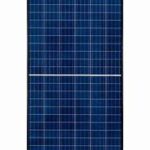
In an era where environmental consciousness and sustainable energy solutions have taken center stage, the quest for efficient and cutting-edge solar panels has never been more paramount. As the global shift towards renewable energy accelerates, the importance of selecting the best solar panels cannot be overstated. In this pursuit of solar superiority, navigating the myriad options available can prove to be a daunting task. Fear not, for we are delighted to embark on a journey that unveils the crème de la crème of solar panel technology, presenting a comprehensive exploration of the best solar panels available in the market.
Table of Contents
Best Solar Panels for Homes
Renogy RNG-100D-SS 100W Monocrystalline Solar Panel
Type: Monocrystalline | Dimensions: 41.8 x 20.9 x 1.38 inches | Wattage: 100 watts
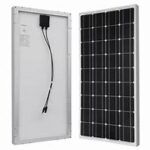
Start your search for the best solar panels with the highest efficiency with monocrystalline panels. Compared to polycrystalline or thin-film panels, this form of solar panel has a higher potential price tag but converts solar energy with a higher efficiency rating. According to the manufacturer, the solar efficiency ratings for these small and light solar panels from Renogy range from 18 to 21 When you comprehend that a significant portion of solar energy is lost as heat, you are at the upper end of the spectrum.
Due to a light aluminum frame, the Renogy 100-Watt Monocrystalline Solar Panel was created to be more compact and weigh less. This makes these solar panels an excellent option for installation on roofs and other uses. These well-liked solar panels have been tested and certified to withstand wind gusts up to 130 miles per hour and snow loads up to 125 pounds per square foot.
Along with IP67 connector cables, this model incorporates an IP65-rated junction box to safeguard against dust and rain. Use these wires to connect this panel to an inverter, which is a device akin to a transformer, so that the energy may be transformed into regular AC electricity. Reonogy Monocrystalline panels can also be connected to one another to form a larger solar array of solar panels for maximum power production.
| Pros | Cons |
| High efficiency rating | No additional items included. |
| Designed to weather elements. |

Nature Power 110W Polycrystalline Solar Panel with Inverter and Charge Controller
Type: Polycrystalline | Dimensions: 39.7 x 1.4 x 26.6 inches | Wattage: 110 watts
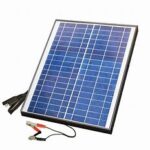
Consider this Nature Power solar panel set if you wish to combine value and convenience. The package contains a 300-watt string inverter, an 11-amp charge controller, and a 110-watt polycrystalline panel. To finish the setup and store the harvested solar energy, you must provide a 12-volt battery.
For increased energy output, you can connect extra Nature Value solar panels, but be aware that doing so requires an upgrade to the controller. The power inverter and charge controller each have a one-year limited guarantee, while the panel has a 25-year limited guarantee.
| Pros | Cons |
| Budget-friendly | Needs an additional 12-volt battery |
| Convenient |
Goal Zero Boulder 100W Monocrystalline Solar Panel
Type: Monocrystalline | Dimensions: 40 x 26.75 x 1.75 inches | Wattage: 100 watts
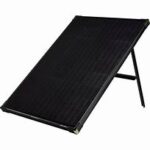
Go-anywhere solar panels made by Goal Zero are known for their sturdiness and lifespan. Just be aware that this 100-watt panel will cost more than you might anticipate. It is roughly twice as expensive as a low-cost 100-watt solar panel, but it boasts a significant 18 percent efficiency rating because of the premium monocrystalline solar cells.
Built with a sturdy aluminum frame, the Goal Zero Boulder 100W Solar Panel. Although it can be placed permanently, it is most frequently used while traveling in conjunction with a portable generator. Although it’s important to note that you can’t modify the angle to maximize the amount of sunlight reaching the monitor, the inbuilt kickstand offers angled support. The warranty is for two years.
| Pros | Cons |
| High-quality monocrystalline solar cells | other alternatives cost less. |
| Integrated kickstand |

Jackery SolarSaga Portable 100W Solar Panel
Type: Portable and made with ETFE | Dimensions: 22.83 x 19.69 x 2.36 inches | Wattage: 100 watts
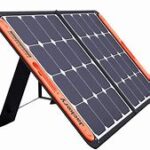
Consider a portable panel for solar energy anywhere the sun shines. A portable solar panel may provide you with the power you require and is frequently used for off-grid applications, outdoor activities, and camping. Use it to run LED lights, a solar generator, or to recharge your electronic devices.
Among folding solar panels, the Jackery SolarSaga is well-liked. This 100-watt, lightweight variant is completely permeable to UV radiation and is composed of the fluorite-based material ETFE. This increases the amount of light that reaches the panel, giving the device an efficiency rating of 23%.
This model is not weatherproof, so you shouldn’t put it outside permanently or keep it out in the rain or snow. It is made for temporary setups and applications only. This solar panel is also produced by Jackery in 60-watt and 200-watt versions.
| Pros | Cons |
| Portable | Not waterproof |
| Lightweight |
Smart Pool S601 Pool Solar Heaters
Type: Passive heating | Dimensions: 240 x 54 x 2 inches | Wattage: Not applicable
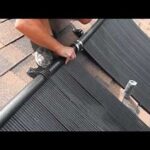
Using the sun’s energy to warm up frigid pool water is another common application for solar energy. By pumping water through tubing, this sort of solar system directly heats water as opposed to photovoltaic panels, which are utilized to produce energy. It is a passive method of pool heating and might be a more affordable option than standard pool heaters. The Smart Pool S601 has a polypropylene tubing system that warms the pool water as it enters by running it through a 4 x 20-foot array.
This model mounts to your roof for out-of-the-way energy production, unlike some solar panels for pools that require square footage on the ground around your pool. Each panel has a surface size of 80 square feet. Multiple solar panels are necessary for larger pools to provide optimal heating effects.
| Pros | Cons |
| Cost-effective | Larger pools need more than one panel. |
| Mounts to your roof to save space. |
Renogy 200-Watt 12-Volt Monocrystalline Solar Starter Kit
Type: Monocrystalline | Dimensions: 20.9 x 1.38 x 41.8 inches | Wattage: 1,000
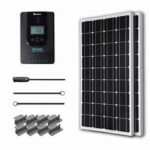
This product from reputable manufacturer Renogy is a solid option for RVers who desire solar electricity for their vehicles. Two 100-watt 12-volt monocrystalline solar panels, a charge controller, an adapter kit, an 8-foot cable, and two mounting bracket sets are all included in a kit that costs less than $300. With a cell efficiency of 22%, the manufacturer says that 5 hours of direct sunshine can generate an average of 1,000 watts of power.
To maintain peak performance, the controller allows four-stage battery charging. Effective heat dissipation is achieved by using a multi-layered TPT backsheet. Given their IP67 rating, the connectors should be able to efficiently block rain and dust, which is crucial when driving. You can attach a Bluetooth module (available separately) to the RS232 connection port and use a downloadable app to track the status of your system from your smartphone.
We like that the package includes the required hardware and pre-drilled holes for relatively simple installation on the roof of a typical RV. The controller is included in the purchase, but there is no battery included. It also lacks a power inverter, which transforms solar DC energy into conventional AC current. Additionally, just like with many modern items, the user manual is only accessible online.
| Pros | Cons |
| Packs 1,000 watts of power | Online-only user manual |
| Good starter system |
Best Solar Panels for Commercial Use
SunPower/Maxeon
Type: Monocrystalline | Dimensions: 20.9 x 1.38 x 41.8 inches | Wattage: 1,000
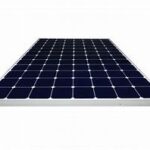
With one of the best efficiency ratings on the market right now, SunPower solar panels (particularly the M-Series and X-Series, which are produced by Maxeon) are a wonderful option for people with small roof spaces or heavy shade. Additionally, they provide a 40-year warranty that is the best in the business, offering SunPower solar panel owners unrivaled peace of mind. If you choose SunPower panels, expect to spend a $5–10,000 premium for your solar panel system due to their efficiency and dependability. This makes the SunPower one of the best solar panels in the market for commercial use.
Type: Monocrystalline | Dimensions: 20.9 x 1.38 x 41.8 inches | Wattage: 1,000
A variety of solar items are produced by the European business REC. If you reside in a region that has continuous heat waves, their newest series, the Alpha Pure-R, is the ideal option because to its remarkable temperature coefficient when compared to other panels.
REC panels are quite effective and complement most roofs well thanks to their black back sheets, frames, and cells. It’s one of the best solar panels in the market fit for both residential and commercial purpose.
| Pros | Cons |
| Well-designed | Expensive. |
| Lightweight |
Final Verdict
In a world shifting towards sustainable energy, the best solar panels stand as beacons of innovation and environmental responsibility. Their remarkable efficiency, longevity, and cost-effectiveness make them a cornerstone of a greener future, empowering us to harness the sun’s power for a cleaner, brighter tomorrow.
Be that as it may, we suggest the Renogy 200-Watt 12 Volt Monocrystalline Solar Panel Starter Kit if you’re a novice searching for a solar system for your RV or motor home because it includes all the gear you need to get powered up quickly and easily.
Best Solar Panels Buying Guide: What to Look for Before buying.
Type
Solar panels can be classified as either monocrystalline, polycrystalline, or thin film. Each differs from the others in terms of the solar cell technology incorporated into the panel.
Monocrystalline panels often cost the most but also offer the best ratings for energy efficiency. You probably need fewer panels on your roof because they also take up less area to achieve the desired level of electricity output. These solar panels, according to their manufacturers, are also more heat resistant and durable. These goods usually come with 25-year or even longer warranties. The biggest drawback is that these solar panels are more expensive than other varieties.
Polycrystalline solar panels: Similar to “mono” panels, polycrystalline solar panels have a tendency to be blue rather than black in color. They are more inexpensive, have a similar lifespan as mono panels, and have a lower temperature coefficient, which means they are more effective as the temperature rises. They don’t perform as well in cloudy weather and take up more space than mono panels.
Thin-film solar panels: Like the other two forms, thin-film solar panels are composed of stacked, 1-micron-thick strips of materials that absorb solar energy. They are not hard like the others; rather, they are quite flexible. Amorphous silicon, cadmium-telluride, and copper indium gallium selenide are the three forms, and their names all refer to their chemical make-up. All are less expensive and perform better in extreme temperatures than mono- or “poly” crystalline solar panels. However, they require greater surface area, have poorer energy efficiency ratings, and have shorter lifespans than the other varieties.
Durability
Durability is crucial to take into account because the best solar panels are installed outdoors. Numerous solar panels intended for fixed installation (such as on the roof of a house, an RV, or a boat) have successfully passed ASTM testing1 to determine their resistance to wind speeds of up to 130 mph and snow loads of up to 125 pounds per square foot.
Some portable, foldable solar panels are not weather-resistant, despite the fact that the majority of panels also contain sealed junction boxes to guard against damage from moisture or dust. Look for one that is water-resistant if you intend to install your panels or leave a portable solar outside, rain or shine. A 66 or higher IP rating is preferred.
Energy Efficiency
The amount of sunlight that the solar panel’s photovoltaic cells are able to convert into electrical energy is referred to as its energy efficiency. Better is a larger proportion. Monocrystalline solar panels of the highest caliber frequently have energy efficiency ratings of 18 to 20 percent. (Remember that the majority of solar energy is lost as heat.) Efficiency ratings for polycrystalline panels typically range from 13 to 15 percent. Only 7% of energy may be converted by thin-film panels.


